 ultimate-guide
Best Time for Lake Tahoe Sunset: Complete 2026 Guide
Table of Contents
- Golden Hour and Blue Hour: Understanding Lake Tahoe Sunset Timing
- Seasonal Sunset Variations at Lake Tahoe
- Top Sunset Viewing Locations Around Lake Tahoe
- How to Choose the Right Sunset Boat Tour in Lake Tahoe
- Best Sunset Boat Tours Lake Tahoe: Your Options
- Weather, Cloud Cover, and Real-Time Sunset Conditions
- Photography and Timing Tips for Lake Tahoe Sunsets
- Accessibility and Logistics for Sunset Viewing
- Frequently Asked Questions
Last Updated: September 1, 2026
Golden Hour and Blue Hour: Understanding Lake Tahoe Sunset Timing
Golden hour occurs in the final 60 minutes before sunset, when the sun sits low on the horizon and bathes the landscape in warm, diffused light. At Lake Tahoe, the Sierra Nevada mountains glow orange and pink, and the water reflects colors you won't see at any other time.
Blue hour follows sunset and lasts roughly 20-40 minutes, depending on the season and elevation. During this period, the sun has dipped below the horizon but still illuminates the sky from below. The light turns deep blue, then purple, then navy. For photographers, blue hour offers a unique quality, the sky and water hold color and detail simultaneously.
What Golden Hour Means for Lake Tahoe
Golden hour at Lake Tahoe creates maximum visual drama as the sun's angle softens shadows and brings out texture in the mountains and water. Arriving 90 minutes before sunset gives you the full golden hour window and time to settle into your location.
Timing shifts significantly by season. In June, golden hour begins around 7:30 p.m.; by December, around 4:15 p.m. Lake Tahoe's elevation of 6,224 feet means higher elevations see golden hour arrive slightly earlier and last slightly longer than lower elevations nearby.
Blue Hour and Twilight Photography
Blue hour is the window serious photographers chase. It occurs after sunset when the sun is between 6 degrees below the horizon and 18 degrees below. At Lake Tahoe, the mountains silhouette against a glowing sky while the water still reflects enough light to show detail.
Blue hour lasts longer in summer than winter. In June, you might have 40 minutes of true blue hour; in December, it compresses to 15-20 minutes. Long exposure photography during blue hour captures the water with mirror-like smoothness while the sky retains color and detail, creating natural contrast difficult to achieve any other way.
Seasonal Sunset Variations at Lake Tahoe
The best time for Lake Tahoe sunset changes dramatically across the calendar. Each season offers different light quality, duration, and viewing conditions.
Summer Sunsets (June to August)
Summer sunsets occur late, between 8:15 p.m. and 9:00 p.m., stretching golden hour to nearly 90 minutes. The extended daylight means boat tours can depart later, and the lake is calmest on average, ideal for photography. However, afternoon thunderstorms around 3:00-5:00 p.m. create unpredictable cloud cover, and crowds peak, popular viewpoints fill by 7:00 p.m., with boat tours booking weeks in advance.
Fall Sunsets (September to November)
Fall is arguably the best time for Lake Tahoe sunset photography. The sun sets between 7:30 p.m. (early September) and 5:00 p.m. (late November). The air is clearer with fewer dust particles and water vapor, so the light is crisper and the mountains show more texture. Crowds thin considerably, and the weather remains warm enough for comfortable outdoor viewing.
By late November, the sun sets before 5:00 p.m., requiring afternoon planning. A 3:00 p.m. boat departure catches the full golden hour and blue hour with fewer visitors on the water.
Winter and Spring Sunsets
Winter sunsets occur early, between 4:30 p.m. (December) and 5:30 p.m. (February). The compressed timeline means golden hour is brief, roughly 45 minutes, but the advantage is clarity, cold air holds fewer particles, and the light is sharp with saturated colors. Snow on the mountains reflects the sunset light, amplifying the effect.
Spring (March to May) is transitional. Sunset times shift from 5:30 p.m. (March) to 8:00 p.m. (May). The light quality improves as you move toward summer, but the air remains clearer than summer, with fewer crowds than summer and more stable weather than winter.
Top Sunset Viewing Locations Around Lake Tahoe
Lake Tahoe's 72-mile shoreline offers dozens of sunset viewpoints. The best locations depend on your preference for crowds, accessibility, and the specific light direction you want to capture.
South Shore Sunset Spots
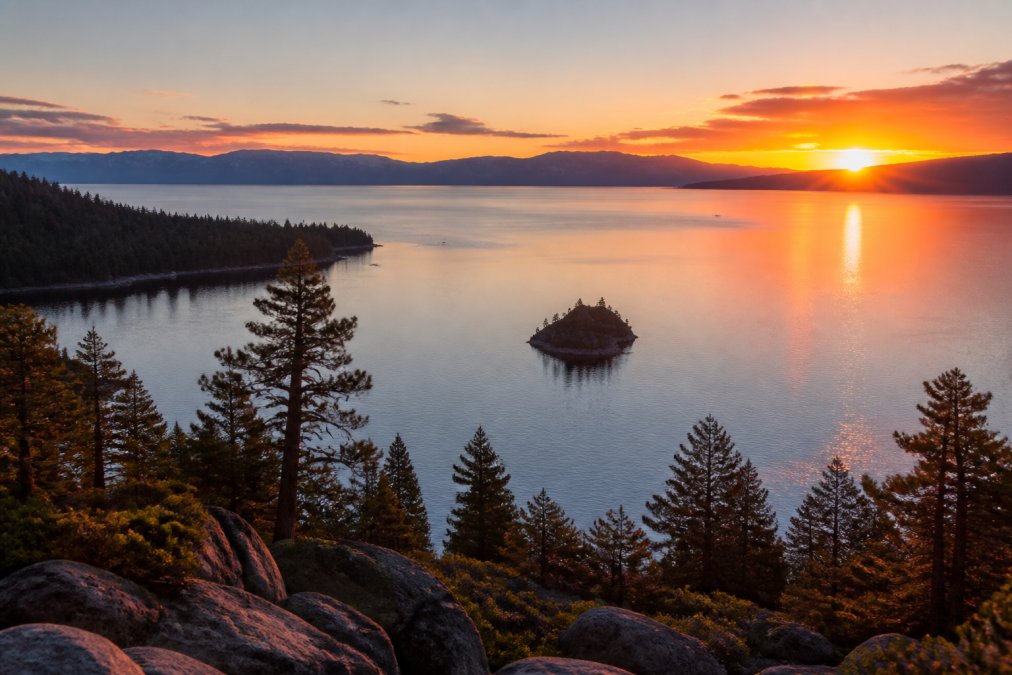
The south shore faces west across the lake toward the Sierra Nevada peaks, creating a natural frame as the sun descends toward the mountains. Emerald Bay is the most photographed sunset location at Lake Tahoe. The bay's unique turquoise water, Fannette Island in the center, and the mountains beyond create a composition that's difficult to improve. Golden hour light on the cliffs above the bay is spectacular, though the viewpoint fills by 7:00 p.m. in summer.
Sand Harbor, a few miles north of Emerald Bay, offers similar views with less crowding. The beach is accessible, and you can position yourself at water level for lower-angle perspectives.
North Shore and East Shore Viewpoints
The north and east shores face west or southwest, so sunset views are less direct. However, these areas offer advantages: fewer crowds, easier parking, and unique perspectives. Sand Harbor North offers views across the lake toward the sunset from a different angle, creating more dramatic shadows and texture.
Emerald Bay and Mountain Rim Views
Emerald Bay's geometry creates a natural amphitheater of mountains. During golden hour, the cliffs catch light and glow, and the water reflects the sky and mountains. Lower positions near the water show the reflection and turquoise color, while higher positions on the overlook show the full landscape.
Parking at Emerald Bay is limited and fills quickly. Arrive by 5:00 p.m. in summer to secure a spot.
How to Choose the Right Sunset Boat Tour in Lake Tahoe
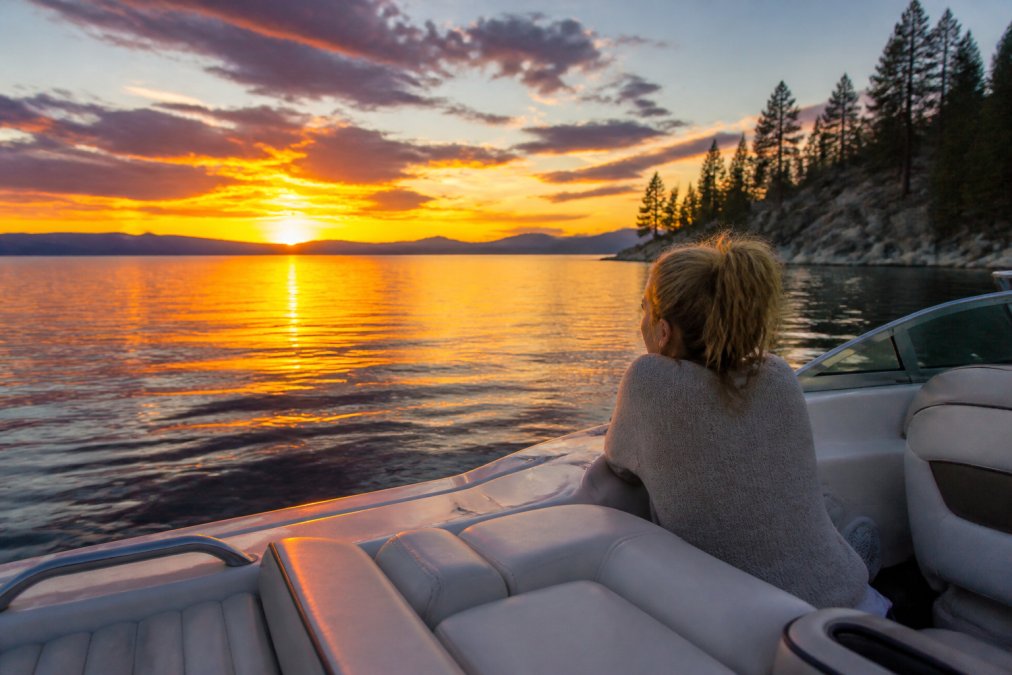
A sunset boat tour combines the beauty of the light with the unique perspective of viewing from the water. The water reflects the sunset light, doubling the visual impact.
Private Charters vs. Group Cruises
Private charters offer flexibility and intimacy. You control the itinerary, departure time, and how long you stay on the water. If clouds roll in, you can adjust your route to find clearer skies. Group cruises depart on fixed schedules and follow preset routes, offering lower per-person cost but less flexibility.
A private charter maxes out at 6-10 people depending on the operator. A group cruise might carry 50-100 passengers. If you're seeking solitude or an intimate experience, private is superior. If you're comfortable in a crowd, group tours are more economical.
What to Look for in a Sunset Cruise Operator
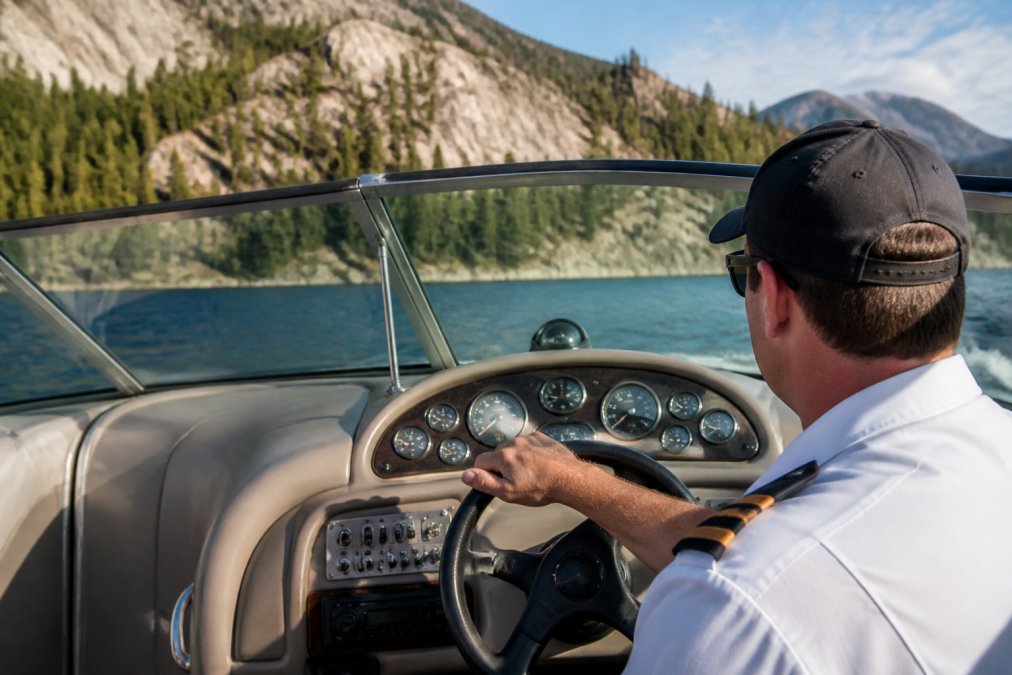
Safety is the first criterion. Verify that the operator holds a USCG license and carries appropriate insurance (uscg.mil). Captain experience matters, a captain with 20+ years on the lake knows how to handle weather changes and navigate safely.
Vessel condition and amenities matter for comfort. A well-maintained boat with a cabin, restroom, and seating for everyone ensures the experience is comfortable. Flexibility in itinerary is valuable, some operators allow you to request specific locations or adjust the route based on weather.
Best Sunset Boat Tours Lake Tahoe: Your Options
Private Charter Experience for Intimate Groups
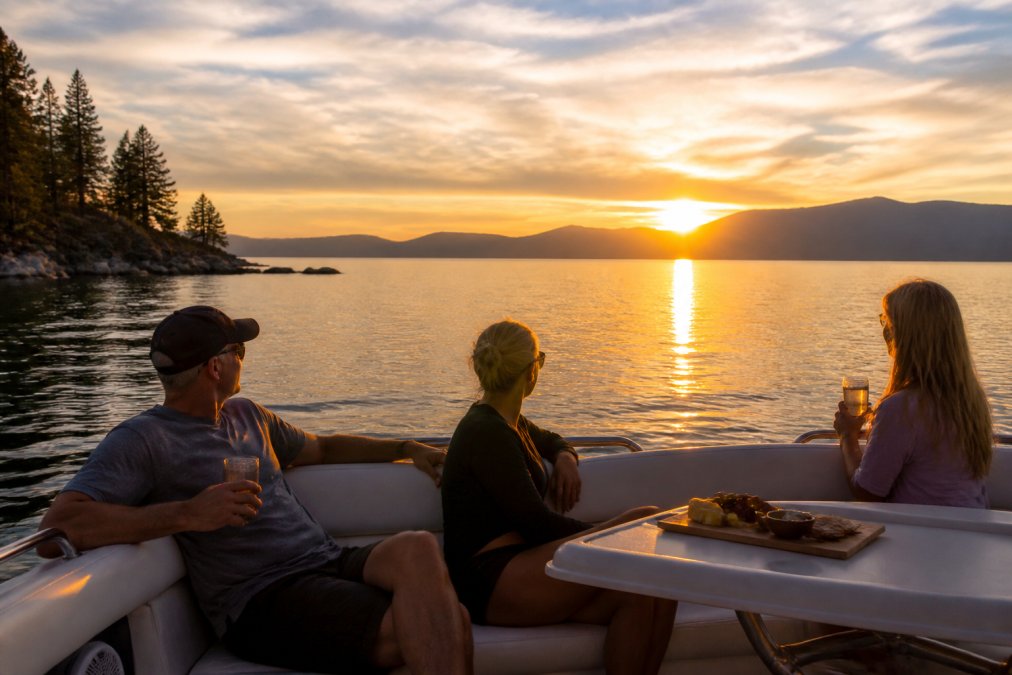
Tahoe Lakeside Charters specializes in private, customized adventures for groups of up to 10 guests. The Formula 330 SS is a premium vessel with a spacious interior, restroom, and comfortable seating. The USCG-licensed captain has 24+ years of professional boating experience and knows Lake Tahoe intimately.
A private charter allows you to time your departure to catch the exact golden hour light you want. You control the route, whether you want to cruise past Emerald Bay, explore the east shore, or find a secluded cove.
Scenic Cruises with Amenities and Refreshments
GetYourGuide offers a Lake Tahoe Scenic Sunset Cruise on a classic 1966 yacht. The 2-hour cruise includes snacks, soda, juice, water, and one complimentary beer, wine, or champagne per person. The boat has indoor space and restrooms, making it comfortable for extended cruising.
Clearly Tahoe offers a unique Sunset Excursion that combines a boat cruise on a 46-foot tri-toon vessel with a 1-hour guided clear kayak tour. The package includes complimentary snacks, non-alcoholic beverages, and one beer or wine per person. Clear kayaks allow you to see underwater scenery during the sunset, a distinctive experience suitable for all ages 4 and up.
Active Sunset Options: Kayaking and Paddleboarding
A guided sunset kayak tour from El Dorado Beach, available through South Tahoe Kayak & Paddleboard, departs in the late afternoon and paddles toward the Upper Truckee River Marsh and Secret Beach. You experience the sunset from water level with views of Mount Tallac and Emerald Bay.
Tahoe Sports Stand Up Paddle Board Rental offers hourly SUP rentals from Tahoe Keys Marina. You rent a paddleboard, personal flotation device, and paddle, then explore at your own pace. This option offers maximum flexibility, though you're responsible for your own safety and navigation.
Weather, Cloud Cover, and Real-Time Sunset Conditions
The most beautiful sunset is worthless if clouds obscure it. Cloud cover is the primary variable, a clear sky produces vivid colors, broken clouds create drama, and complete cloud cover can be disappointing. Check real-time conditions within 24 hours of your planned outing.
Wind affects water conditions. Calm water reflects the sunset light like a mirror, doubling the visual impact.
How Atmospheric Conditions Shape Your Sunset
Atmospheric clarity determines light quality. On clear days, the air contains fewer particles, so light travels directly from the sun to your eyes and to the water. The colors are vivid and saturated. On hazy days, particles scatter light, diffusing it and softening colors.
Lake Tahoe's elevation of 6,224 feet means the air is thinner than at sea level, affecting how light scatters and how colors appear. Sunsets at elevation often show more vivid colors.
Planning Around Mountain Elevation and Horizon Effects
The Sierra Nevada mountains create a unique horizon for Lake Tahoe sunsets. The mountains frame the sun as it descends, creating a natural focal point. The elevation of the peaks (many exceed 10,000 feet) means the sun takes longer to fully set compared to sunsets over flat terrain.
Different locations on the lake see the sunset at different times because the mountain rim is irregular. A location with a lower mountain profile sees the sun set earlier than a location with higher peaks blocking the view.
Photography and Timing Tips for Lake Tahoe Sunsets
Photographing a Lake Tahoe sunset requires understanding light, camera settings, and positioning.
Camera Settings: Shutter Speed, Aperture, and Long Exposure
Shutter speed controls how much light reaches the sensor. During golden hour, you can use faster shutter speeds (1/500 to 1/1000 second). During blue hour, you need slower shutter speeds (1-5 seconds) or higher ISO.
Aperture (f-stop) controls depth of field. For landscape photography, apertures between f/8 and f/16 keep the entire scene in focus. Long exposure photography during blue hour using shutter speeds of 10-30 seconds creates smooth, mirror-like water surfaces while the sky retains color and detail (peer-reviewed research). This requires a tripod and neutral density filter to prevent overexposure.
ISO (sensor sensitivity) is a trade-off between brightness and noise. During golden hour, low ISO (100-400) produces clean images. During blue hour, you may need higher ISO (800-3200) to maintain usable shutter speeds, accepting some noise as a trade-off.
Wide-Angle Lenses and Tripod Setup
Wide-angle lenses (14-35mm) capture the expansive landscape. A 24mm lens is a good compromise, wide enough to show context but not so wide that the sunset itself becomes small in the frame.
A tripod is essential for consistent framing and for long exposures during blue hour. Lower positions (shooting from water level) emphasize reflections. Higher positions (shooting from overlooks) show more landscape.
Timing Your Arrival and Positioning
Arrive at your chosen location 90 minutes before sunset. This gives you time to scout positions, set up your camera, and acclimate to the light. Position yourself with the sun to your side or behind you, not directly ahead. Shooting into the sun creates lens flare and silhouettes.
Check your camera's histogram during shooting. The histogram shows whether your exposure is correct, not too bright (blown highlights) or too dark (crushed shadows).
Accessibility and Logistics for Sunset Viewing
Practical considerations, parking, trailhead access, and physical accessibility, determine whether a sunset location is realistic for your group.
Parking and Trailhead Access
Popular sunset locations fill quickly. Emerald Bay parking reaches capacity by 5:00 p.m. in summer. Arriving early is the simplest solution, arrive by 4:00 p.m. in summer, 5:00 p.m. in fall and spring, and 3:30 p.m. in winter.
Trailhead access varies. Some viewpoints are accessible from parking areas with short walks (under 0.5 miles). Others require moderate hikes (1-3 miles) or strenuous climbs. Winter parking is complicated by snow, some parking areas close during heavy snow, and others require chains or four-wheel drive. Check current conditions before planning a winter sunset outing.
Sunset Viewing for Mobility-Impaired Visitors
Several Lake Tahoe sunset locations offer accessible viewing for visitors with mobility limitations. Sand Harbor has accessible parking and a relatively flat walk to the beach. Emerald Bay overlook has accessible parking and a short walk to the main viewpoint. Highway 50 Vista Points have accessible parking with short walks to overlooks.
Boat tours are accessible for visitors who can board a vessel. Most Lake Tahoe tour boats have stairs or ramps and interior seating. Verify accessibility when booking, as some smaller boats have limitations. Dining at waterfront restaurants like Edgewood Restaurant offers sunset views without hiking or physical activity.
Frequently Asked Questions
Q: What is the best time of year to see a sunset at Lake Tahoe?
A: Fall (September through November) offers the most vibrant sunsets, with crisp air and clear skies creating intense golden and orange hues. Summer provides long daylight hours and consistent weather, while winter offers dramatic color contrasts. The best time depends on your priorities: fall for color intensity, summer for extended golden hour, or spring for fewer crowds and unpredictable but spectacular cloud formations.
Q: How long before sunset should I arrive at a viewing spot?
A: Arrive 30-45 minutes before the official sunset time to capture the early golden hour. This gives you time to set up photography equipment, find the best vantage point, and watch the light transition from warm tones to deeper oranges and reds. For boat tours, arrive at the dock 15-20 minutes early to board and settle in before departure.
Q: How do I choose the right sunset boat tour in Lake Tahoe?
A: Consider group size (private charters offer personalization for small groups, while scenic cruises work for larger parties), amenities included (refreshments, restrooms, seating), captain credentials (look for USCG-licensed captains with local experience), and your activity level (relaxing cruises vs. kayaking or paddleboarding options). Check reviews, verify safety certifications, and confirm flexibility for weather delays or rescheduling before booking.
Q: Does the sunset look different from the water versus the shore?
A: Yes. From the water, you experience an unobstructed 360-degree view and the reflection of colors across the entire lake surface, creating a more immersive experience. Shore-based viewing offers stability and easier photography setup but can be limited by elevation, trees, and mountain shadows. Water-based viewing extends your golden hour window because you're at lake level, away from mountain shadows that can block shore views earlier.
Watching the sunset at Lake Tahoe is one of the most memorable experiences the region offers. The key to maximizing the moment is understanding when and where to position yourself for the best light, and planning around weather and crowds. Whether you choose a private sunset cruise with Tahoe Lakeside Charters, a guided kayak tour, or a viewpoint hike, the effort to plan around the best time for Lake Tahoe sunset pays off in an experience you'll remember long after you leave the lake.
This article was written using GrandRanker