
 ultimate-guide
Why Hire USCG Licensed Captains for Your Private Charter
Table of Contents
- What a USCG Captain's License Actually Means
- USCG Charter Boat Regulations: When Is a License Legally Required?
- Boating Safety Requirements for Private Charters
- Hiring a Captain for a Private Boat Rental: What It Costs vs. What You Get
- Insurance and Liability: Why Your Policy May Not Cover You
- Captain for Hire vs. Bareboat Charter: The Legal Distinction
- How to Vet a Licensed Captain Before You Book
- Conclusion: Safety, Experience, and Peace of Mind
- Frequently Asked Questions
Last Updated: September 10, 2026
What a USCG Captain's License Actually Means
A USCG captain's license is a federal credential issued by the U.S. Coast Guard that authorizes an individual to operate a commercial vessel and carry paying passengers. It is the legal benchmark for anyone who takes your family out on the water for hire. At Tahoe Lakeside Charters, every trip runs with a USCG-licensed captain because the license is the baseline, not a bonus.
To earn it, a candidate must document sea time, pass a background check, complete an approved training course, and pass a written exam covering navigation rules, safety, and emergency procedures. The Coast Guard then issues a Merchant Mariner Credential with a specific endorsement for the waters and vessel size the holder is cleared to operate, a captain licensed for inland waters is not automatically cleared for coastal waters.
Training and Testing Requirements
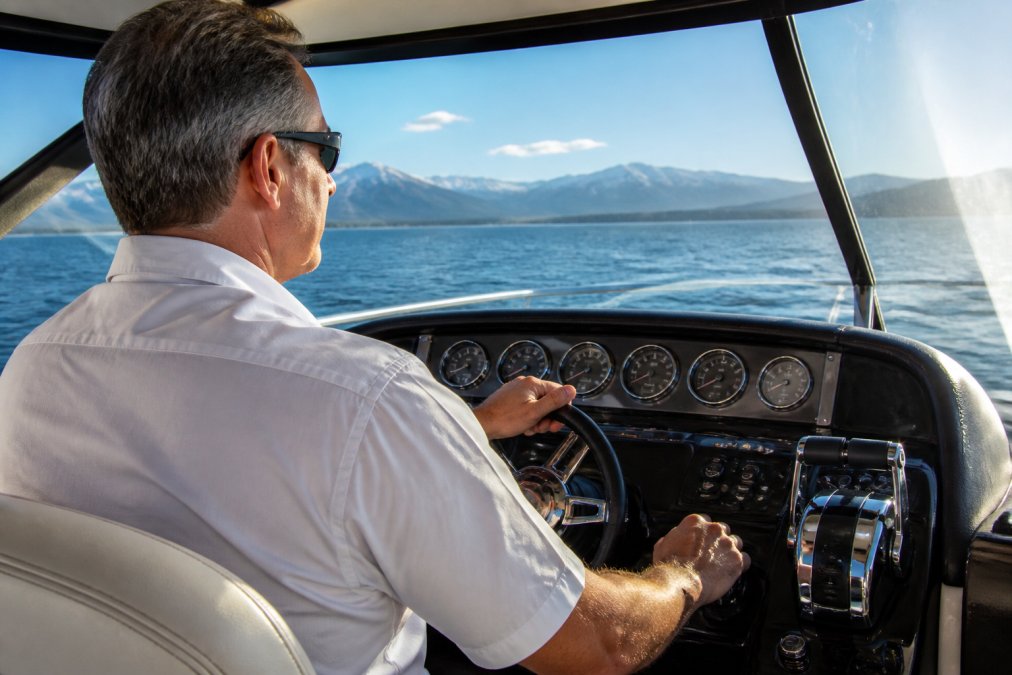
The training is not a weekend seminar. Applicants must show documented time on the water, complete a Coast Guard-approved course, and pass an exam testing navigation rules, emergency response, and vessel safety. First aid and CPR certification are typically required, along with a drug test and physical.
The Six-Pack License Explained
The most common credential for private charters is the OUPV license, widely called the six-pack license because it permits carrying up to six passengers (uscg.mil). That is the tier most private boat rentals fall under, and it is issued with endorsements for specific waters.
USCG Charter Boat Regulations: When Is a License Legally Required?
A license is legally required the moment a vessel carries passengers for hire. Anyone who takes money, goods, or anything of value in exchange for carrying people on the water is running a commercial operation, and commercial operations fall under Coast Guard regulations. There is no informal exemption for a friend with a boat who accepts gas money.
The U.S. Coast Guard boating safety portal outlines how these rules apply to recreational versus commercial use. The distinction is not about the size of the boat or the length of the trip. It is about whether money changed hands. A charter boat carrying paying guests is a commercial vessel, full stop, and the operator must hold the right credential for that service.
Inspected vs. Uninspected Passenger Vessels
An uninspected passenger vessel is a small commercial boat carrying six or fewer passengers, not subject to the same structural inspection regime as a larger inspected vessel. Most private charters operate here. An inspected passenger vessel carries more passengers and undergoes regular Coast Guard inspection of hull, machinery, and safety equipment.
The practical takeaway: uninspected does not mean unregulated. It means the captain's credential and required safety gear carry the compliance burden rather than a scheduled hull inspection. Both categories still require a licensed operator, life jackets for every person aboard, and a fire extinguisher.
Boating Safety Requirements for Private Charters
Safety requirements for private charters start with the captain's credential and extend to the equipment on board. Federal rules require wearable life jackets for every passenger, throwable flotation, a fire extinguisher, visual distress signals, and a sound-producing device, all confirmed before leaving the dock (uscgboating.org).
What separates a good operation from a merely legal one is how the captain reads conditions. Mountain lakes are notorious for sudden afternoon wind, and a captain who has run the same water for years knows when to change course before the chop builds.
How Licensed Captains Handle Emergencies and Rough Water
Licensed captains train for emergencies before they ever need to use that training. Man-overboard drills, fire response, and rough-water handling are part of the exam material. When wind picks up, the response is procedural: reduce speed, angle into the swell, and keep passengers seated and calm.
For families with kids prone to motion sickness, this matters more than any other factor. A captain who anticipates the chop and adjusts the route keeps the ride comfortable; one who does not turns a scenic cruise into a rough one.
Hiring a Captain for a Private Boat Rental: What It Costs vs. What You Get
Hiring a captain for a private boat rental is not just an add-on cost; it is the line between a legal charter and an illegal one. If you own a boat and want to rent it out with an operator, that operator must be licensed. If you are a guest booking a charter, the captain is included in what you pay, and the value shows up in legal compliance, safety, and local knowledge.
Pricing for private charters depends on the vessel, duration, and season, so ask for a quote rather than trust a generic number. What you are paying for is a credentialed professional who carries the liability, knows the water, and can find the calm coves on a windy day.
Insurance and Liability: Why Your Policy May Not Cover You
Most boat owners assume their policy follows the boat. It does not. A recreational marine policy is written around a defined use, typically "private pleasure", and that definition is the hinge on which coverage turns. The moment you accept money, goods, or anything of value to carry passengers, you have stepped outside the described use, and an insurer can deny a claim even if the loss had nothing to do with the payment.
The Policy Clauses That Actually Decide a Claim
You do not need to read the whole policy. Four provisions do most of the work:
- The declarations page and "use" definition. This is where "private pleasure" or "pleasure use only" appears. If your on-water activity does not fit that phrase, you are outside the contract.
- The business or commercial pursuits exclusion. Nearly every recreational policy contains one. It typically excludes any activity involving a fee, charter, or the carrying of persons for compensation, and it does not require the fee to be the point of the trip.
- The seaworthiness and due-diligence clause. Insurers can reduce or deny a claim if the vessel was not maintained or operated with reasonable care. An unlicensed operator is strong evidence against you on this point.
- The named-operator or approved-operator provision. Some policies require that anyone operating the vessel be listed or meet stated experience criteria. An unlisted operator at the helm during a loss can void coverage for that occurrence.
A common pattern is a claim that looks routine, a dock strike, a grounding, a passenger injury, and then gets denied not because of the accident, but because the use fell outside the policy. Coverage depends on what the boat was doing, not how careful the operator was.
How Hiring a Licensed Captain Changes the Risk Picture
When you hire USCG licensed captains through a properly structured charter business, the commercial liability sits with that business, not with you. The operator carries commercial marine liability coverage written for passenger-carrying use, and the captain's credential is part of what makes that coverage valid. Insurers underwrite commercial marine policies around licensed operation; an unlicensed operator is often an outright underwriting bar.
For a boat owner who wants to rent out a vessel with an operator, this cuts the other way. You cannot hand your boat to a friend with a license and assume your recreational policy will respond. The vessel may need to be added to a commercial policy, or the arrangement may need to run through the operator's own coverage.
What to Ask Before You Rely on Anyone's Insurance
- Ask whether the operation carries commercial marine liability coverage, and ask for the certificate of insurance, not a verbal assurance.
- Confirm the policy covers passenger-carrying for hire, not just vessel operation.
- Ask whether the captain is an employee or an independent contractor, because that affects who is responsible if something goes wrong.
- Ask what the per-occurrence and aggregate limits are, and whether there is a separate medical payments provision for passengers.
- If you are the boat owner, ask in writing how your vessel and your personal exposure are addressed under the operator's policy.
A reputable charter business answers these questions without hesitation. Evasiveness about insurance is the biggest red flag, because it is the one gap that cannot be fixed after an accident.
The Bottom Line on Liability
Hiring a licensed captain is not just about who is qualified to drive the boat. It is about which insurance policy is on the hook when something goes wrong, and whether that policy was ever written to cover the activity. A credentialed captain operating under a commercial policy keeps the risk with the business; an informal cash arrangement keeps the risk with you.
Captain for Hire vs. Bareboat Charter: The Legal Distinction
The distinction between a captain for hire and a bareboat charter comes down to who commands the vessel, but the consequences of getting it wrong go far beyond who sits in the helm seat. These are two different legal structures with different insurance requirements, qualification burdens, and liability outcomes.
What Each Structure Actually Is
In a captained charter, the vessel is provided with a licensed operator. The guests are passengers. Command, navigation, and legal responsibility rest with the credentialed captain and the charter business. The guests do not need boating experience.
In a bareboat charter, the renter takes full command. No captain is provided. The renter is the operator for legal purposes, which means the renter must be qualified to run the vessel and must carry, or be covered by, insurance that contemplates the renter at the helm.
Why Misclassification Is a Real Risk
The trouble starts when an arrangement is labeled one thing but functions as another. A "bareboat" rental where the owner's friend drives the boat, or where the owner stays aboard and gives directions, can be recharacterized as a captained charter, and if no licensed captain is actually in command, the operation may be running outside federal passenger-for-hire rules. The reverse also happens: a captained charter marketed as a bareboat to avoid licensing is still a commercial passenger operation.
The classification is not determined by what the contract calls it, but by who actually exercises command and control of the vessel. If a licensed captain is directing the operation, it is a captained charter regardless of the paperwork. If the renter is truly in command, it is a bareboat charter, and the renter carries the legal weight.
The Insurance and Qualification Consequences
The two structures trigger different insurance needs. A captained charter should be covered by the operator's commercial marine liability policy, written for passenger-carrying use. A bareboat charter typically requires the renter to have their own coverage, or to be added to the owner's policy under a bareboat charter endorsement, because the owner's recreational policy generally will not respond to a rental arrangement.
Qualification follows the same split. In a captained charter, the captain's Merchant Mariner Credential and endorsement are the qualification. In a bareboat charter, the renter must demonstrate the experience and competence to operate the vessel, which is why bareboat operators commonly ask for a boating resume, a certification, or a check-out ride.
Which One Fits Your Trip
If your goal is a relaxed day on the water with family or friends, the captained model removes the burden from you entirely. You are a passenger. The licensed captain carries the legal authority, operational responsibility, and insurance. You do not need to prove experience, and you are not the operator if something goes wrong.
If you are an experienced boater who wants to run the boat yourself, a bareboat charter can make sense, but only if you are genuinely qualified, you understand that you are the operator for legal purposes, and you have confirmed in writing that the insurance covers you at the helm.
The practical rule: if a licensed captain is in command, you are on a captained charter and the risk sits with the business. If you are in command, you are on a bareboat charter and the risk sits with you.
How to Vet a Licensed Captain Before You Book
Vetting a captain takes about five minutes if you know what to ask. The credential is verifiable, the operator should be willing to show it, and a few pointed questions reveal whether you are dealing with a professional or a hobbyist.
Use this checklist before you commit:
- Ask to see the captain's Merchant Mariner Credential and confirm the endorsement matches the waters you will be on
- Confirm the operation carries commercial marine liability insurance
- Ask how many years the captain has run the specific body of water, not just boats in general
- Ask what the weather contingency plan is and whether you can reschedule
- Confirm the passenger limit matches your group size (six is the standard OUPV ceiling)
- Ask what safety equipment is aboard and where life jackets are stored
A captain who answers these questions directly is almost certainly the real thing. Evasiveness on credentials or insurance is the clearest red flag there is.
Conclusion: Safety, Experience, and Peace of Mind
Choosing a charter is really a decision about who carries the risk. A credentialed captain carries the legal authority, the insurance, and the local judgment that keep a day on the water safe and easy. Tahoe Lakeside Charters runs every trip with a USCG-licensed captain who brings 24 years of professional boating experience, a premium Formula 330 SS for a stable and comfortable ride, and private itineraries for groups of up to 10 guests. Get started with Tahoe Lakeside Charters and turn a boat ride into a day your crew will remember.
Frequently Asked Questions
Why is it safer to hire a USCG-licensed captain for private charters?
A USCG-licensed captain has passed background checks, drug testing, and written exams covering navigation rules, emergency procedures, and maritime law. They carry a Merchant Mariner Credential, which verifies their identity and qualifications. On the water, they handle sudden weather shifts, mechanical issues, and passenger emergencies with training that recreational boaters simply don't have. This level of preparation reduces risk for everyone aboard.
Are all boat charter operators required to have a USCG license?
Yes, if they carry passengers for hire. Federal regulations require any vessel carrying more than six passengers to have a licensed captain, and even smaller charters fall under USCG charter boat regulations. An operator running without a license is breaking the law and likely uninsured. Before booking, ask to see the captain's Merchant Mariner Credential and verify it through the Coast Guard's online database.
What does a USCG captain's license actually signify?
It shows the captain has met federal standards for sea time, training, and testing. They've logged hundreds of hours on the water and passed exams on navigation, safety, and regulations. The license also requires ongoing drug testing and physical exams. When you hire a licensed captain, you're getting someone who has been vetted by the Coast Guard, not just someone with boating experience.
How do I verify a captain's credentials before booking?
Ask for the captain's Merchant Mariner Credential number and check it on the Coast Guard's National Maritime Center website. You can also request proof of insurance and ask about their experience on the specific body of water you'll be cruising. A reputable operator will provide this information without hesitation. If they dodge the question, that's a red flag.