 comparison
Private Boat Charter vs Public Tours: What to Know
Table of Contents
- Private Boat Charter vs Public Tours: Key Differences at a Glance
- Cost Comparison: Per-Person Tickets vs Per-Charter Pricing
- Privacy and Exclusivity: Your Own Vessel vs a Shared Cruise
- Itinerary Control: Customized Routes vs Fixed Schedules
- The Benefits of Private Boat Charters for Families and Groups
- Choosing the Best Time for Boat Tours with Kids
- Safety, Experience, and What to Look For
- Making the Call: Which Option Fits Your Trip?
- Frequently Asked Questions
Last Updated: September 8, 2026
Choosing between a private boat charter vs public tours often comes down to one question: what kind of day do you actually want on the water? For families and small groups visiting Lake Tahoe, that answer usually separates a memorable, personalized outing from a crowded, schedule-bound excursion. This guide breaks down the real trade-offs so you can book with confidence.
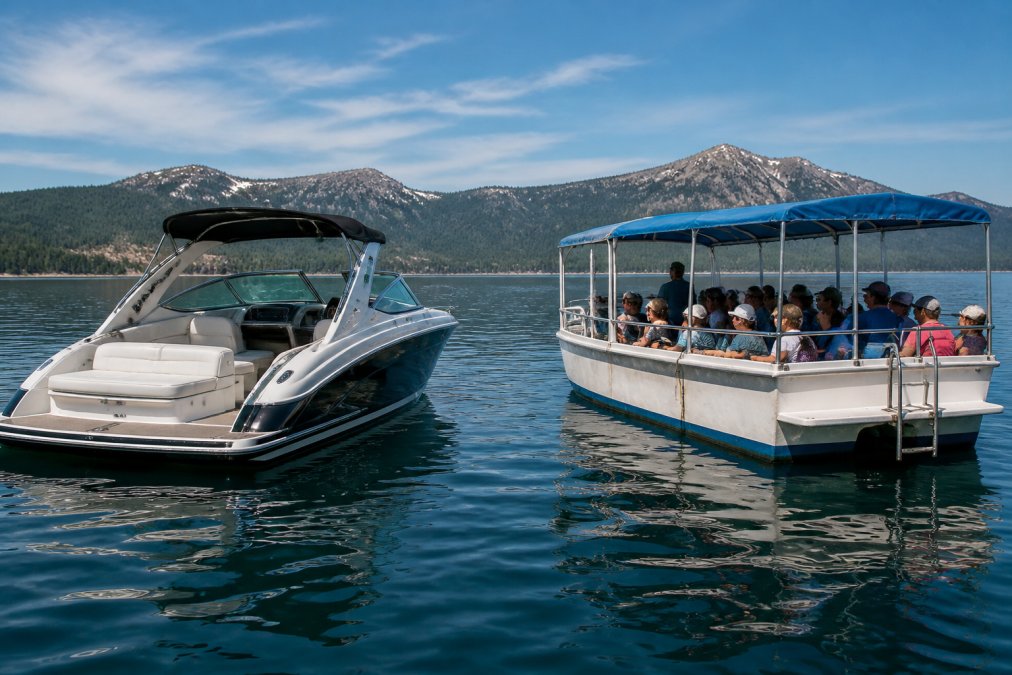
A private boat charter is the exclusive rental of an entire vessel with your own captain, while a public tour places you on a shared cruise with a fixed itinerary and other passengers. The distinction reshapes your cost structure, privacy, schedule, and flexibility on the water.
Private Boat Charter vs Public Tours: Key Differences at a Glance
Public tours operate on a fixed schedule with a passenger manifest that can include dozens of strangers. A private charter flips that model: you get the whole vessel, a captain-led experience tailored to your group, and the freedom to change plans as the day unfolds.
| Feature | Private Charter | Public Tour |
|---|---|---|
| Pricing model | Per-charter fee | Per-person ticket |
| Group size | Just your party | Shared with strangers |
| Itinerary | Fully customizable | Fixed route |
| Schedule | Flexible departure | Set times |
| Privacy | Exclusive experience | Shared space |
| Vessel capacity | Your group only | Up to full capacity |
| Food & drink | BYOB allowed | Often restricted |
| Personalization | High | Low |
Cost Comparison: Per-Person Tickets vs Per-Charter Pricing
Public tours win on sticker price for solo travelers and couples. However, the math shifts dramatically once your group grows.
For families or groups of six or more, a private boat charter becomes surprisingly competitive. Dividing the total charter fee across your party often lands close to premium public tour ticket prices, and you gain the entire vessel. Public tours frequently add fees for onboard amenities, drinks, or activities, while a private charter consolidates everything into one transparent price.
A public ticket buys you a seat. A private charter buys you the boat, the captain's undivided attention, and the ability to do what you want, when you want. For special occasions or once-in-a-lifetime trips, that difference justifies the premium.
Privacy and Exclusivity: Your Own Vessel vs a Shared Cruise
Privacy is the single most tangible difference. On a public tour, you share the deck, the rails, and the views with however many tickets were sold that day. On a private charter, the only people aboard are your group and the captain.
For couples on a honeymoon or families wanting quality time without strangers nearby, that exclusivity transforms the experience. You can speak freely, play your own music, and relax without feeling watched, with no jostling for a good photo spot.
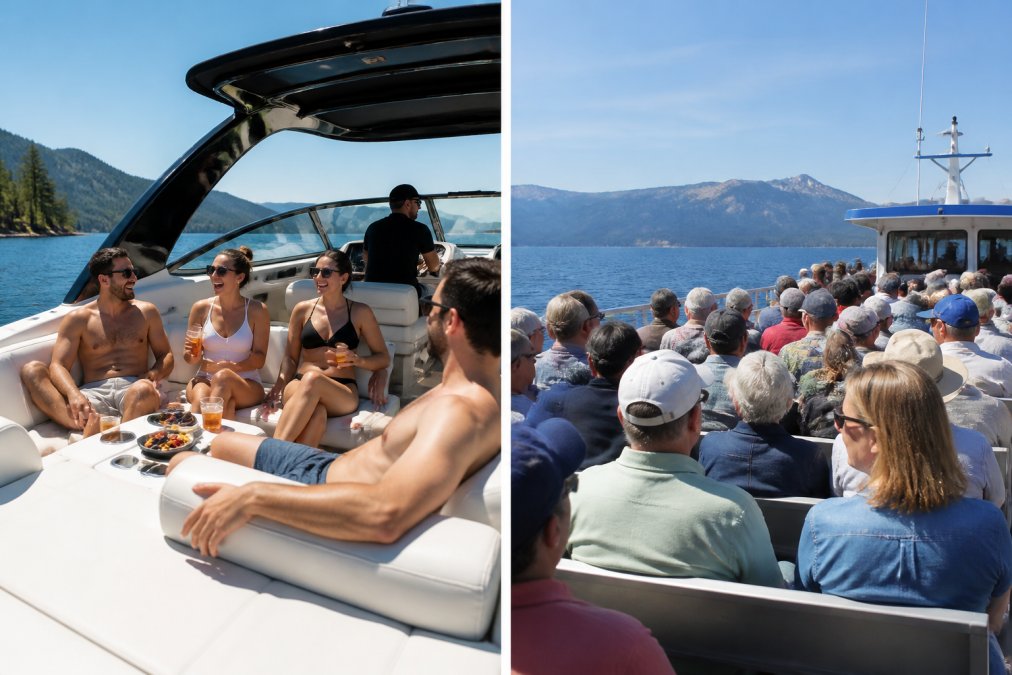
The privacy level extends to your activities. Want to swim in a secluded cove without an audience? On a shared cruise, that is rarely an option. On your own vessel, the captain can pull into a quiet spot and you can jump in without a second thought.
Itinerary Control: Customized Routes vs Fixed Schedules
A public tour follows a predetermined route with set stops and a strict timeline. The boat departs whether you are ready or not, and you move on when the clock says so.
A private charter inverts this relationship. You set the agenda, whether that means cruising past iconic landmarks, finding the best swimming spots, or anchoring in a quiet bay. If the group wants to spend an extra 20 minutes at a snorkeling stop, you can; if someone wants to head back early, you can.
This flexibility is especially valuable for families with young children, whose energy and attention spans rarely follow a fixed schedule. Your captain is there to guide, not to herd you along.
The Benefits of Private Boat Charters for Families and Groups
The benefits of private boat charters become most obvious when traveling with people you care about. For families, the private setting means parents can relax without tracking kids around strangers, and children can move about freely in a safe, contained environment.
Groups of friends get the freedom to curate the vibe. A private boat charter is essentially your own floating gathering spot, where you can bring your own snacks and drinks and play your own music. Most public tours restrict outside food and beverages, while private charters typically welcome them.
For multi-generational trips, the customizable pace is invaluable. Seniors can enjoy a comfortable, stable ride without feeling rushed, while younger members can enjoy water activities like tubing. A licensed captain provides local knowledge and a safe, smooth ride tailored to the group's comfort level.
Choosing the Best Time for Boat Tours with Kids
Timing is a critical factor with children, but the decision goes beyond picking a morning or afternoon departure. A private charter lets you align the schedule with your family's specific needs, including accessibility and special needs, something most public tour schedules cannot accommodate.
The Logistics of Departure: Why Flexibility Matters
Public tours depart at fixed times, often with a check-in window 30-45 minutes prior, creating a rigid schedule that can be stressful for families managing a child's nap time, medication schedule, or dietary needs (nps.gov). A private charter offers a departure time that works for your family. If your child needs a late morning, you can book an 11:00 AM departure instead of a 9:00 AM public tour.
Accessibility and Special Needs: A Critical Consideration
This is a topic almost every guide ignores, yet it is the deciding factor for many families. Public tour boats often have steep gangways and multiple steps to access the main deck and restrooms, making boarding a challenge for a parent with a stroller, a child with mobility issues, or an elderly grandparent. Navigating crowded decks with a wheelchair or walker is often impossible.
Private charters, particularly modern sport cruisers or deck boats, often offer a more accessible boarding experience. Many have a swim platform at the stern that sits closer to dock level, reducing the step height. Some have a hydraulic swim lift to lower a person in a wheelchair or with limited mobility safely into the water, a feature you will never find on a public tour boat.
The Best Time of Day for a Sensory-Friendly Experience
For children with sensory processing sensitivities, the noise and crowding of a public tour can be overwhelming. A private charter offers a controlled sensory environment: you can choose a quieter vessel, request reduced engine noise, and control music volume. The best time is often the first departure of the day, when the water is calmest and the lake is quietest.
Weather Windows and Water Conditions
While morning is generally calmer, the 'best' time is also dictated by the lake's microclimate. Afternoon winds create a chop that can be uncomfortable for small children. A private charter allows a game-time decision: book a morning slot if afternoon winds are forecast, or shift your departure if the afternoon is predicted to be sunny and calm. Public tours run rain or shine, on their schedule, not on the weather best for your child.
Booking Lead Time and Spontaneity
Public tours require planning around their calendar, often booking days or weeks in advance. Private charters often have more last-minute availability during the week, allowing you to react to your child's health and mood. If your child woke up with a cold, you can postpone without losing non-refundable tickets. This flexibility reduces the financial risk of booking a day that might not work out.
Safety, Experience, and What to Look For
Safety isn't just about life jackets; it's about the regulatory framework and liability structure governing your trip. The difference is not just who is on board, but who is legally responsible for what happens.
The Regulatory Divide: USCG Licensing and Inspections
All commercial passenger vessels in the United States must operate under a Coast Guard-issued Certificate of Inspection (COI), which dictates maximum passenger capacity, required safety equipment, and manning requirements (uscg.mil).
The key difference lies in the captain's license. A captain with a 'Six-Pack' license is legally permitted to carry no more than six passengers (uscg.mil). If your group is larger than six, the vessel must be operated by a captain with a higher-level license. When booking a private charter, ask: "What is your license tonnage and passenger endorsement?" A captain with the correct license for your group size is a non-negotiable safety requirement.
Insurance and Liability: Who is Responsible?
This is the most overlooked aspect of the booking process. Public tour operators carry commercial marine liability insurance covering the general public. As a ticketed passenger, your recourse for an incident is typically limited to the operator's policy, and their liability for negligence is often capped or subject to waivers you sign at the dock.
A private charter shifts the risk profile. The charter contract outlines the operator's liability and your own. Before you sign, ask for proof of insurance and clarify what it covers, including your group's personal property and damage caused by guests. Ask for the specifics.
The Captain's Role: Pilot, Guide, and Safety Officer
On a public tour, the captain is often in a wheelhouse while a mate handles passengers. On a private charter, the captain is your direct point of contact for the entire trip. A good private captain will conduct a thorough safety briefing tailored to your group and assess guests' physical capabilities, adjusting the itinerary to avoid rough water for someone with a back injury or ensure a safe entry point for a less confident swimmer.
What to Look For in a Vessel
The physical condition of the boat reflects the operator's safety culture. Look beyond the gel coat; check upholstery and railings for excessive wear, and ask when the last USCG inspection was. On a public tour, you have no choice in the vessel. On a private charter, you are selecting the specific boat, so ask pointed questions about its age, engine hours, and maintenance schedule.
Tipping etiquette is a final practical detail. On a private charter, a gratuity of 15-20% of the charter fee is standard, reflecting the personalized service and the captain's expertise.
Making the Call: Which Option Fits Your Trip?
If you are traveling solo or as a couple on a strict budget, a public tour delivers a cost-effective way to see the lake. If you want a personalized, exclusive experience with itinerary control, privacy, and freedom, a private boat charter is the clear winner.
The deciding factor is usually group size and what you value most. For families and groups of friends, the per-person cost of a charter becomes reasonable, and the benefits of having your own captain and vessel are substantial. Public tours are a fine introduction to the lake; private charters are how you create the day you will actually remember.
Choosing between the two comes down to whether you want a seat on someone else's schedule or command of your own day. Tahoe Lakeside Charters offers private, customized adventures for groups of up to 10 aboard a premium Formula 330 SS, with a USCG-licensed captain holding 24+ years of experience guiding the way. Bring your own snacks and drinks, set your own route, and skip the crowded tour boats entirely. Get started with Tahoe Lakeside Charters and book your private Lake Tahoe experience today.
Frequently Asked Questions
How does the cost of a private boat charter compare to a public tour?
A private boat charter is priced per trip, not per person, so the total upfront cost is higher than a single ticket on a public tour boat. However, for groups of six or more, the per-person cost becomes much closer to what you would pay for individual tickets. A private charter also includes the entire vessel, the captain's dedicated attention, and a customized itinerary, which changes the value equation beyond just the ticket price.
Are private boat charters better for families with children?
Yes, private boat charters offer clear advantages for families. You control the pace, which helps with shorter attention spans, and you can plan around nap times or meal schedules. The boat is yours alone, so there is more room for children to move safely under the captain's guidance. You can also bring your own snacks and drinks, which simplifies things for picky eaters and keeps everyone comfortable.
How much should I tip for a private boat tour?
Tipping your captain is standard practice for a private boat charter. A typical range is 15-20% of the total charter cost, similar to what you would tip for other personalized service. If the captain went out of their way to find great swimming spots or made the trip special for your group, tipping at the higher end of that range is appropriate. Cash is always appreciated.
What is the typical capacity for a private boat charter versus a public tour?
A private boat charter capacity depends on the specific vessel and its USCG certification. Public tour boats vary much more widely, often carrying 50 to 150 or more passengers. This difference in vessel capacity directly affects the noise level, the amount of personal space, and your access to the captain on a private boat charter.